SEO Case Study: How a New Website Can Increase Google Search Impressions
Launching a new website is only the first step toward building organic search visibility. New websites often receive limited impressions because search engines need time to discover pages, understand their content, and determine their relevance to search queries. This case study explains how a new website can build Google Search impressions through technical SEO, keyword research, search intent analysis, and a structured content strategy.
From a brand-new site to broader search visibility.
The Challenge
Industry: Digital Marketing
Website Type: New Business Website
Primary Goal: Increase organic search impressions
SEO Approach: Technical SEO, on-page SEO, keyword targeting, and internal linking
A newly launched website faces several SEO challenges. Search engines may not have enough information to understand its services, target audience, and topical relevance. Some pages may not be indexed, while others may target keywords with limited search demand or strong competition.
The main challenges in this scenario were:
- Limited visibility in Google Search results.
- Low initial impressions for target keywords.
- New service pages without established search performance.
- Limited internal links between related pages.
- Insufficient content targeting different stages of search intent.
The objective was to establish a strong SEO foundation and increase the number of relevant search queries for which the website could appear.
The SEO Strategy
1. Technical SEO Audit
The first step was to evaluate the website’s technical health. This included checking XML sitemaps, robots.txt, canonical tags, mobile usability, page status codes, and indexability.
Google Search Console was used to monitor indexing status and identify pages that were not appearing in search results. Technical issues were prioritized so that search engines could access and process important website pages.
2. Keyword Research and Search Intent
Keyword research was performed to identify relevant search terms based on user needs, service relevance, and potential search demand. Instead of targeting only broad keywords, the strategy included specific long-tail queries such as:
- SEO services for small businesses
- Technical SEO services
- Local SEO services in Bangalore
- B2B SEO strategy
- Website SEO audit services
Keywords were mapped to relevant landing pages and supporting articles to reduce unnecessary overlap and improve topical relevance.
3. On-Page SEO Optimization
Important landing pages were optimized with descriptive title tags, relevant meta descriptions, clear H1 and H2 headings, and useful page content.
Content was written to answer users’ questions and explain services clearly. Relevant terminology was incorporated naturally, without excessive keyword repetition.
4. Content Expansion
Supporting blog articles were created around relevant SEO topics. These articles targeted informational searches and linked to related service pages where appropriate.
This approach helped the website cover a wider range of topics and create additional opportunities to appear for relevant search queries.
5. Internal Linking
Relevant internal links were added between blog posts, service pages, and related resources. Descriptive anchor text helped users navigate the website and provided search engines with additional context about the relationships between pages.
6. Google Search Console Monitoring
Google Search Console performance data was reviewed to evaluate total impressions, clicks, average click-through rate, and average position.
Queries receiving impressions were analyzed to identify content opportunities. Pages appearing for relevant queries but receiving few clicks were reviewed for title relevance, search intent, and snippet quality.
How Impressions Can Increase for a New Website
Google Search impressions can increase when a website begins appearing for more relevant queries, when existing pages become eligible to appear more frequently, or when pages gain visibility in search results.
For example, a new SEO services page might initially appear for only a few specific searches. After content improvements and better internal linking, it may begin appearing for additional related queries.
Impressions can therefore grow even before significant organic traffic develops. However, increasing impressions does not automatically mean rankings, clicks, or leads have improved.
Results and Performance Measurement
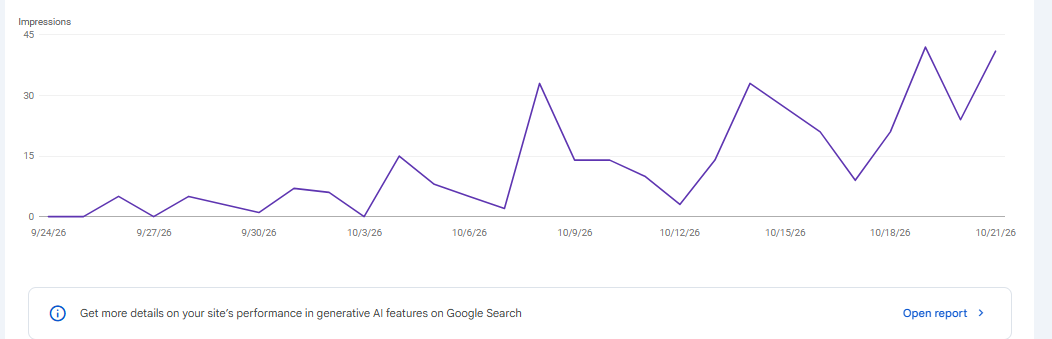
The expected outcome of this strategy is broader search visibility and more opportunities to attract relevant visitors. Actual performance should be measured using verified Google Search Console data.
Key metrics include:
Total impressions: How often website pages appeared in Google Search results.
Total clicks: How many clicks the website received from those results.
Average CTR: The percentage of impressions that generated clicks.
Average position: The average position of the website’s search results.
Indexed pages: The number of relevant pages indexed by Google.
Organic leads: Enquiries attributed to organic search.
To demonstrate real growth, compare equivalent reporting periods and account for changes in website content, search demand, seasonality, and the number of pages published.
Key Learnings
A new website can build search visibility by establishing technical accessibility, targeting relevant keywords, publishing helpful content, and connecting related pages through internal links.
SEO is an ongoing process rather than a one-time activity. Monitoring impressions and query-level performance helps identify opportunities to improve content and strengthen organic search visibility over time.
A strong foundation, guided by real data.
Increasing Google Search impressions for a new website requires a combination of technical SEO, keyword research, search intent optimization, useful content, and ongoing performance analysis.
At SEOBuzz, our approach focuses on building a strong SEO foundation that helps businesses improve organic visibility and develop sustainable opportunities for traffic and lead generation.
Sharief Mohsin
SEOBuzz helps businesses improve online visibility and generate qualified leads through SEO, Google Ads management, conversion tracking and performance-driven digital marketing.
Founded by Sharief Mohsin, who brings five years of SEO experience across in-house and agency work.
Launching a new website?
Talk to SEOBuzz about building the technical foundation, keyword strategy and content plan that help a new site earn more search impressions.